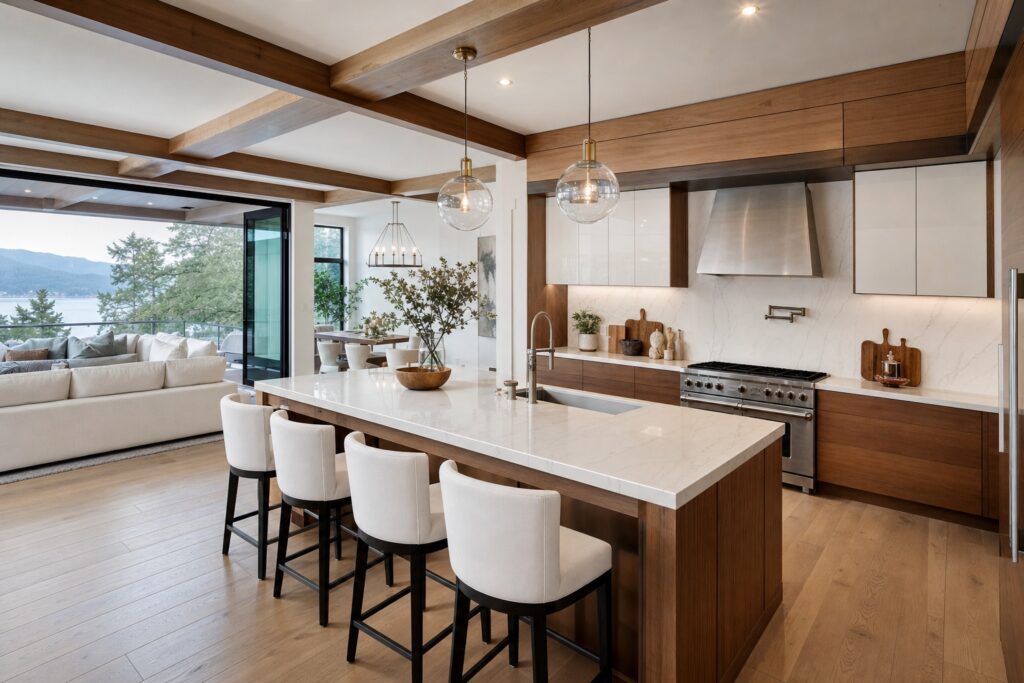
Most Metro Vancouver homeowners believe kitchen renovations automatically increase home value, but the reality is more nuanced. A poorly planned kitchen reno can actually hurt resale value, while a strategic upgrade can return 70-100% of the investment. The difference comes down to scope, budget alignment, and understanding what buyers in your specific BC municipality actually want.
After 25 years in construction and nearly a decade running projects across Vancouver, North Vancouver, West Vancouver, and Burnaby, I’ve seen kitchen renovations transform homes and create genuine equity. I’ve also seen homeowners overcapitalize on upgrades that don’t match their neighborhood or market segment. The question isn’t whether kitchen renovations are worth it. It’s whether your specific renovation plan makes financial sense for your goals, timeline, and property.
This guide breaks down the real costs, returns, and strategic considerations for kitchen renovations in Metro Vancouver’s unique housing market. You’ll learn what upgrades deliver value, what mistakes to avoid, and how to structure a renovation that pays off whether you’re staying put or planning to sell.
The Real ROI of Kitchen Renovations in Metro Vancouver
Kitchen renovations typically return 60-80% of their cost at resale in Metro Vancouver’s current market. That percentage varies dramatically based on project scope, home value, and neighborhood. A $40,000 kitchen renovation in a $900,000 Burnaby bungalow might return 75% because it brings the home to market standard. The same budget in a $2.5 million West Vancouver property might only return 50% because buyers expect luxury finishes regardless.
The key metric isn’t just resale value. It’s functional value during ownership. If you plan to live in your home for 5-10 years, the daily quality-of-life improvement from a well-designed kitchen justifies the cost even if resale returns are modest. If you’re flipping or selling within two years, ROI becomes critical.
Arash Amini and the team at Avangard Development track renovation returns across Metro Vancouver projects, and the data shows three factors consistently drive higher ROI: layout optimization over cosmetic upgrades, quality mid-range materials over luxury finishes, and projects that stay within 10-15% of neighborhood kitchen standards. Overcapitalizing kills returns faster than any other mistake.
The timeline matters too. Kitchen renovations completed during strong seller’s markets see better returns than those finished during buyer’s markets. In 2026, Metro Vancouver’s market has stabilized after previous volatility, making strategic renovations more predictable for planning purposes.
What Drives Kitchen Renovation Costs in BC
Material costs represent 30-40% of total kitchen renovation budgets in Metro Vancouver. Labor accounts for another 40-50%. The remaining 10-30% covers permits, engineering (if structural changes occur), project management, and contingency for unforeseen issues. These ratios shift based on project complexity.
A basic cosmetic refresh with new cabinets, countertops, and appliances runs $20,000-$40,000 for a standard 10×12 kitchen. Mid-range renovations with layout changes, new flooring, lighting upgrades, and quality finishes cost $50,000-$80,000. High-end custom kitchens with structural modifications, premium materials, and luxury appliances easily reach $100,000-$150,000 or more.
BC-specific factors increase costs compared to other provinces. Stricter seismic requirements under the BC Building Code add engineering costs when removing walls. Metro Vancouver municipal permit fees vary by city, with Vancouver typically charging more than Burnaby or North Vancouver. Strata buildings require additional approvals and often restrict work hours, increasing labor costs.
The biggest hidden cost is project delays. Every week a kitchen renovation runs over schedule costs money in extended labor, material price fluctuations, and lost functionality. Working with experienced teams who understand construction project management and BC permit processes prevents these overruns.
High-Value Kitchen Upgrades That Actually Pay Off
Not all kitchen improvements deliver equal value. Some upgrades appeal to broad buyer pools and justify their cost. Others satisfy personal taste but don’t move resale needles. Understanding the difference prevents wasted investment.
Layout improvements consistently deliver the highest returns. Converting a closed galley kitchen to an open-concept space, adding an island, or improving the work triangle creates functional value every user experiences. These changes often require structural work, permits, and engineering, but they transform how the space performs.
Cabinet replacement or refacing ranks second for value impact. Buyers notice cabinet quality immediately. Solid wood construction with soft-close hardware and functional storage solutions like pull-out organizers and corner solutions justify premium pricing. You don’t need custom cabinetry to achieve this. Quality semi-custom options offer 80% of the visual impact at 60% of the cost.
Countertop material matters, but not as much as homeowners think. Quartz has become the Metro Vancouver standard because it balances durability, aesthetics, and maintenance. Upgrading from laminate to quartz returns well. Jumping from quartz to exotic marble rarely returns the premium unless your home is already in the luxury segment.
Energy-efficient appliances appeal to BC buyers who face rising utility costs. Induction cooktops, Energy Star-rated refrigerators, and efficient dishwashers add value while reducing operating costs. The savings justify slightly higher upfront investment for most homeowners staying in place more than three years.
Through hundreds of renovation projects across Metro Vancouver, Avangard Development has identified that lighting upgrades deliver disproportionate value relative to cost. Under-cabinet LED strips, proper task lighting, and updated fixtures transform kitchen functionality for $2,000-$5,000, returning nearly dollar-for-dollar at resale.
When Kitchen Renovations Don’t Make Financial Sense
Three scenarios consistently produce poor ROI on kitchen renovations: overcapitalizing for the neighborhood, renovating immediately before selling, and making purely cosmetic changes when functional issues exist.
Overcapitalization happens when renovation budgets exceed what neighborhood comps support. Installing a $120,000 custom kitchen in a $750,000 East Vancouver home surrounded by $700,000-$800,000 properties means you’ll never recover that investment. Buyers shopping that price range won’t pay $870,000 when comparable homes sell for $800,000 with decent kitchens.
Renovating within six months of selling typically loses money. You pay full renovation costs but don’t enjoy the space long enough to justify the investment. Buyers discount the value because they didn’t choose the finishes. Unless your kitchen is truly dysfunctional and preventing sale, minor cosmetic updates deliver better returns than full renovations when selling soon.
Cosmetic updates that ignore functional problems waste money. Replacing cabinets and countertops while leaving poor layout, inadequate storage, or outdated electrical creates a pretty kitchen that doesn’t work well. Buyers notice during inspections. The renovation looks good but doesn’t command premium pricing because functionality remains compromised.
Permit avoidance is another value killer. Unpermitted work creates disclosure requirements in BC that spook buyers and kill deals. Even if the work is high quality, lack of permits suggests potential code violations. Buyers either walk away or demand price reductions that exceed what proper permits would have cost.
Strategic Timing and Scope for Maximum Return
The best time to renovate a kitchen is 2-5 years before you plan to sell and immediately after purchase if the space is truly dysfunctional. This timeline lets you enjoy the upgraded space while capturing resale value when it matters.
Renovation scope should match your ownership timeline. Planning to live in your home for 10+ years? Invest in exactly what you want because personal enjoyment justifies the cost. Selling in 3-5 years? Stick to market-standard finishes and proven layouts that appeal to broad buyer demographics.
Phasing can make sense for budget-conscious homeowners. Tackling layout changes, structural work, and core functionality first creates immediate improvement. Cosmetic upgrades like backsplash, hardware, and paint follow later when budget allows. This approach requires careful planning to avoid duplicating work or creating mismatched aesthetics.
Seasonal timing affects both cost and convenience. Kitchen renovations during fall and winter often secure better contractor availability and potentially lower labor rates than spring’s peak season. However, permit processing times remain consistent year-round across Metro Vancouver municipalities.
Working with builders experienced in pre-construction planning helps identify the optimal scope and sequence. Arash Amini’s approach at Avangard Development involves detailed cost-benefit analysis before finalizing plans, ensuring renovation scope aligns with financial goals and timeline realities specific to each Metro Vancouver property.
Alternatives to Full Kitchen Renovations
Full gut renovations aren’t always necessary. Several alternatives deliver significant improvement at lower cost and shorter timelines.
Cabinet refacing replaces doors, drawer fronts, and hardware while keeping existing boxes. This works when cabinet boxes are structurally sound and the layout functions well. Cost runs 40-50% of full replacement while achieving 70-80% of the visual impact. Turnaround time is 1-2 weeks instead of 6-8 weeks for full replacement.
Countertop replacement with updated backsplash transforms kitchen aesthetics without touching cabinets or layout. Paired with new fixtures and hardware, this approach costs $8,000-$15,000 and takes 3-5 days. It works best when cabinets are already good quality and layout is functional.
Appliance upgrades with minor cosmetic improvements often suffice when selling a home with dated but functional kitchen. New stainless appliances, fresh paint, updated lighting, and new hardware cost $6,000-$12,000 total and make the space feel current without major construction.
Minor layout tweaks sometimes achieve major functional gains. Removing a short wall section to open sightlines, adding a small island, or reconfiguring a pantry improves daily use without full renovation scope. These projects require permits but cost 30-40% less than complete overhauls.
The right approach depends on your specific situation. A licensed builder can assess whether your kitchen benefits more from targeted improvements or comprehensive renovation. This evaluation considers structural condition, layout efficiency, material quality, and your goals for the space.
Maximizing Kitchen Renovation Value Through Smart Planning
The difference between kitchen renovations that pay off and those that disappoint comes down to planning discipline. Three planning principles consistently produce better outcomes: setting realistic budgets with 15-20% contingency, prioritizing function over aesthetics, and working with experienced teams who understand Metro Vancouver’s regulatory environment.
Budget realism matters more than initial estimates suggest. Kitchen renovations routinely encounter surprises once walls open: outdated wiring requiring panel upgrades, plumbing that needs replacement, structural issues requiring engineering. These aren’t contractor tricks. They’re realities of renovating homes built under older codes. The 15-20% contingency isn’t optional padding. It’s protection against predictable unknowns.
Function-first design means asking hard questions about how you actually use your kitchen. Do you need that six-burner range if you rarely cook? Would that corner space work better as storage than seating? Does the island need seating on two sides or is one sufficient? Honest answers prevent spending money on features that don’t improve daily life.
Working with teams experienced in design-build renovation services streamlines decision-making and reduces change orders that inflate costs. Single-source responsibility means the team designing your kitchen understands construction realities, municipal requirements, and cost implications before finalizing plans.
Permit coordination shouldn’t be an afterthought. Every Metro Vancouver municipality has specific requirements for kitchen renovations involving structural changes, electrical upgrades, or plumbing modifications. Vancouver, North Vancouver, West Vancouver, and Burnaby each interpret BC Building Code slightly differently. Experienced builders navigate these variations without delays or failed inspections.
Material selection benefits from insider knowledge about what performs well versus what looks good in showrooms. Some trendy finishes scratch easily, stain readily, or require intensive maintenance. Others deliver years of trouble-free service while looking just as good. This knowledge comes from installing thousands of kitchens and seeing what holds up.
Founded in 2017, Avangard Development has refined kitchen renovation processes across residential projects throughout Metro Vancouver. The company’s open-book approach to construction management gives homeowners full transparency on costs, timelines, and trade-offs, eliminating the uncertainty that typically surrounds renovation decisions.
Frequently Asked Questions
How much does a typical kitchen renovation cost in Metro Vancouver?
Kitchen renovation costs in Metro Vancouver range from $20,000 for basic cosmetic updates to $150,000+ for high-end custom projects. Most mid-range renovations with layout changes, quality materials, and new appliances run $50,000-$80,000. Costs vary based on kitchen size, material selections, structural modifications, and whether you’re working in a house or strata building with additional restrictions.
What kitchen upgrades provide the best return on investment?
Layout improvements that enhance functionality deliver the highest returns, typically 70-90% of cost at resale. Cabinet replacement or quality refacing, quartz countertops, energy-efficient appliances, and improved lighting all return 60-80% while significantly improving daily usability. Upgrades that bring your kitchen to neighborhood standards return better than luxury finishes that exceed local market expectations.
Do I need permits for kitchen renovations in Metro Vancouver?
You need permits for any kitchen work involving structural changes, electrical modifications, plumbing alterations, or gas line work. Simple cabinet and countertop replacement without layout changes typically doesn’t require permits. Requirements vary slightly between Vancouver, North Vancouver, West Vancouver, and Burnaby. Unpermitted work creates disclosure obligations and can complicate future sales, making proper permitting worth the cost and time.
How long does a kitchen renovation take from start to finish?
Timeline depends on project scope. Cosmetic updates like cabinet refacing take 1-2 weeks. Mid-range renovations with layout changes require 6-8 weeks from demolition to completion. Complex projects involving structural modifications, custom cabinetry, or strata approvals can take 10-14 weeks. Add 2-4 weeks for design and permit approval before construction starts. Experienced builders provide realistic timelines based on specific project details.
Should I renovate my kitchen before selling my Metro Vancouver home?
Renovate before selling only if your kitchen is truly dysfunctional or severely outdated compared to neighborhood standards. If selling within six months, minor cosmetic updates like paint, hardware, and new appliances deliver better returns than full renovations. If you have 2+ years before selling, a strategic renovation lets you enjoy the improvement while capturing resale value. Match your renovation scope to neighborhood expectations rather than personal preferences.
Kitchen renovations are worth it when they align with your timeline, budget, and property goals. The key is strategic planning that balances functional improvement, aesthetic appeal, and financial return. Overcapitalizing kills value. Underspending leaves opportunity on the table. The sweet spot comes from understanding your specific property, neighborhood dynamics, and Metro Vancouver market realities.
Arash Amini brings 25 years of construction experience and deep knowledge of Metro Vancouver’s building landscape to every renovation project. Since founding Avangard Development in 2017, the company has completed kitchen renovations across Vancouver, North Vancouver, West Vancouver, Burnaby, and surrounding municipalities, consistently delivering projects that enhance both daily living and long-term property value. Ready to explore whether a kitchen renovation makes sense for your property? Book a free consultation to discuss your specific situation, get transparent cost estimates, and develop a renovation strategy that delivers genuine returns.