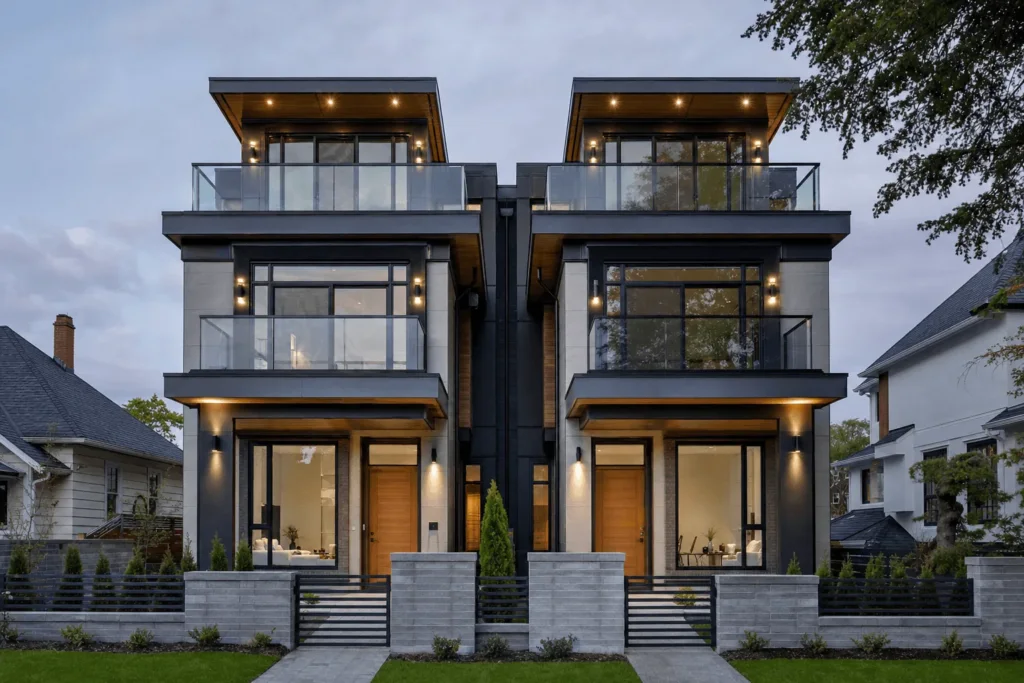
Building a multiplex in Metro Vancouver represents a substantial financial commitment that requires careful planning and transparent cost analysis. Whether you’re considering a triplex, fourplex, or sixplex development, understanding the complete budget picture helps you make informed feasibility decisions before engaging contractors or committing to a project. This guide breaks down every cost category, from hard construction expenses to municipal development charges, and explains how contract structures affect your final investment.
We’ll explore real Metro Vancouver multiplex economics, compare different unit configurations, examine recent BC housing legislation impacts, and show you how to avoid the most common budgeting mistakes that derail development projects.
Quick Answer
Multiplex construction costs in Metro Vancouver typically range from $1.2 million for a basic triplex to over $4 million for a premium sixplex, including land, construction, design, permits, and development charges. Final costs depend on unit count, finish level, site conditions, and municipal fee structures.
Multiplex Construction Cost in Metro Vancouver: 2026 Overview
The multiplex development landscape in Metro Vancouver has shifted dramatically since BC’s housing legislation changes took effect. What used to require lengthy rezoning processes now often falls under permitted use in many municipalities, but that doesn’t mean the costs have decreased.
Total all-in multiplex costs break down into five major categories: land acquisition, hard construction costs, soft costs (design and engineering), municipal fees and charges, and financing costs. Each category represents a significant portion of your budget, and underestimating any one of them creates financial stress mid-project.
Hard construction costs typically represent 50-60% of your total budget on already-owned land. Soft costs add another 15-25%, while municipal development charges can range from $50,000 to over $300,000 depending on the municipality and unit count. Financing costs accumulate throughout the 18-24 month development timeline.
Key Takeaways
- Expect total multiplex costs from $1.2M to $4M+ including all fees
- Budget 15-20% contingency for unforeseen site conditions and code changes
- Compare contract structures carefully as they allocate cost risk differently
- Factor municipal development charges early as they vary drastically by city
- Choose experienced Metro Vancouver builders familiar with local multiplex regulations
Cost and Budget Considerations
Comprehensive multiplex budgeting requires integrating all cost categories into a realistic total project budget with adequate contingencies for the unknowns inherent in any construction project. Your budget should function as a decision-making tool throughout development, not just an initial feasibility calculation.
Start with accurate land valuation. If you already own the property, obtain a current market appraisal or use recent comparable sales to establish realistic land value. Hard construction costs require detailed estimating based on your specific design, site conditions, and finish selections.
Soft costs accumulate from project conception through construction completion. Budget for architectural fees, all engineering disciplines, permit fees, surveying, geotechnical investigation, arborist reports, legal fees for financing and stratification, insurance, and accounting fees. Municipal development charges vary by location and require research into your specific municipality’s current fee schedules.
Financing costs depend on your funding structure. Your contingency allocation should reflect project risk level. Simple sites with good soil conditions might justify 12-15% contingency. Complex sites or ambitious architectural designs warrant 18-20% or more.
Complete Multiplex Budget Breakdown: Five Cost Categories
Every multiplex project requires comprehensive budgeting across five distinct cost categories. Missing or underestimating any category leads to budget shortfalls that can stall or compromise your project.
Land Acquisition and Opportunity Costs
If you’re purchasing land specifically for multiplex development, acquisition costs typically represent 20-30% of your total project budget. Land prices in Metro Vancouver vary enormously by municipality and neighborhood, from $800,000 for a teardown lot in some Burnaby areas to over $3 million for premium Vancouver Westside locations.
But what if you already own the property? Many developers mistakenly exclude land value from their feasibility analysis because they’re not writing a cheque for it. This creates flawed economics. Your land has market value whether you bought it yesterday or inherited it decades ago. Opportunity cost matters. That land could be sold today for cash. By choosing to develop it into a multiplex, you’re investing that value into the project just as surely as if you’d purchased it.
Financing Costs and Construction Loan Considerations
Construction financing for multiplex projects typically involves a construction loan that advances funds in stages as work progresses. Interest rates for construction loans in 2026 typically range from prime plus 1-3%, with rates varying based on your financial profile and lender relationship.
Unlike a traditional mortgage where you borrow the full amount upfront, construction loans advance money in draws tied to completion milestones. You only pay interest on the advanced portion, which helps control carrying costs during the build. Total financing costs over a two-year development timeline can add 6-10% to your project budget when you factor in construction loan interest, interim financing fees, appraisal costs, and legal fees associated with the lending arrangement.
Arash Amini and the Avangard Development team recommend securing financing pre-approval before finalizing architectural plans. Lender requirements for parking ratios, unit sizes, or construction methods may affect your design, and discovering conflicts after paying for full architectural drawings wastes time and money.
Hard Construction Costs: Per Square Foot and Unit Count Analysis
Hard construction costs represent the physical building work: foundation, framing, roofing, mechanical systems, finishes, and site development. This category typically consumes the largest portion of your construction budget and shows the most variation based on your finish choices and site conditions.
Wood-frame multiplex construction in Metro Vancouver typically ranges from $225 to $350 per square foot for the building itself, depending on finish level. A basic spec with vinyl siding, laminate counters, and builder-grade fixtures sits at the lower end. Mid-range finishes with fiber cement siding, quartz counters, and quality appliances push toward $275-300 per square foot. Premium builds with architectural details, high-end finishes, and custom millwork exceed $325 per square foot.
These per-square-foot figures apply to the building only. Site work adds substantially to hard costs. Depending on your property’s existing conditions, you’ll need to budget for demolition of existing structures, lot grading, utility connections, parking area construction, landscaping, and retaining walls if you’re building on a sloped lot.
A typical fourplex in Metro Vancouver ranges from 4,000 to 6,000 square feet of total building area. At $275 per square foot, that’s $1.1 million to $1.65 million for the building alone, before adding site work, which commonly adds another $100,000 to $250,000 depending on complexity.
Wood-Frame vs Alternative Construction Methods
While most Metro Vancouver multiplexes use wood-frame construction, alternative methods exist. Steel-frame construction costs 15-25% more than wood-frame but offers greater structural flexibility and dimensional stability. Insulated Concrete Form (ICF) construction adds 20-30% to framing costs but delivers superior energy efficiency and sound isolation between units. Prefab/modular construction can reduce on-site timeline by 30-40% but typically doesn’t reduce total hard costs and requires crane access. For most multiplex projects under six units, wood-frame remains the most cost-effective approach in Metro Vancouver’s current market.
Soft Costs: Design, Engineering, Permits, and Professional Fees
Soft costs represent the professional services, permits, and administrative expenses required to take your project from concept to building permit and through construction. These costs typically range from 15-25% of your hard construction costs, and they begin accumulating long before any physical construction starts.
Architectural design fees for multiplex projects typically range from $45,000 to $120,000 depending on project complexity and the level of architectural detail. Structural engineering adds another $15,000 to $35,000 for complete structural design and stamped drawings. Other engineering disciplines add to this: civil engineering for site servicing and drainage ($8,000-$15,000), geotechnical investigation ($3,000-$8,000), and energy modeling for BC Energy Step Code compliance ($2,500-$6,000).
Surveying costs include legal surveys, building location certificates, and construction layout: budget $5,000 to $12,000 total. Arborist reports required by most Metro Vancouver municipalities when mature trees exist on site add $1,500 to $3,500. Building permit fees themselves typically run $15,000 to $35,000 for a complete multiplex, calculated based on construction value.
The pre-construction planning process coordinates all these soft cost elements efficiently, ensuring engineering work aligns with architectural design, permit applications include all required documentation, and timelines sequence properly to avoid delays.
City Development Fees: DCL, DCC, and Municipal Charges
Municipal development charges represent one of the most variable cost categories in multiplex budgeting. These fees vary dramatically between Metro Vancouver municipalities, and they can add anywhere from $50,000 to over $300,000 to your project cost.
Development Cost Levies (DCL) charged by municipalities like Vancouver help fund city infrastructure, affordable housing, parks, and community facilities. Vancouver’s DCL structure for residential development varies by neighbourhood and development type. Development Cost Charges (DCC) flow to Metro Vancouver regional government and fund regional infrastructure: major roads, water supply systems, and sewage treatment.
The multiplex development charges Vancouver specifically can exceed $200,000 for a fourplex when you combine city DCL, regional DCC, school site acquisition charges, and utility connection fees. Fee schedules change regularly. Municipalities adjust DCL and DCC rates annually or biannually based on updated infrastructure funding needs.
| Municipality | Typical Total Fees (Fourplex) | Major Components |
|---|---|---|
| City of Vancouver | $180,000 – $250,000 | DCL, regional DCC, utility fees |
| City of Burnaby | $120,000 – $180,000 | DCC, community benefit, utilities |
| City of North Vancouver | $100,000 – $150,000 | DCCs (multiple categories), permit fees |
| District of North Vancouver | $110,000 – $160,000 | DCCs, park contributions, utilities |
Cost Comparison: Triplex vs Fourplex vs Sixplex Economics
Unit count dramatically affects both total project cost and development economics. Understanding the triplex vs fourplex vs sixplex cost relationship helps you optimize your investment for your specific property and financial goals.
A triplex on a standard Metro Vancouver lot represents the smallest true multiplex configuration. Total all-in costs typically range from $1.2 million to $2.0 million including land, construction, and all fees. With three rental units, your rental income and eventual sale value spread across fewer units, which affects your return metrics.
Fourplex building cost typically ranges from $1.8 million to $2.8 million all-in. That fourth unit doesn’t add 33% to your triplex costs because many expenses remain relatively fixed. You’re building one foundation, one roof system, and one building envelope, just with more internal divisions. The marginal cost of the fourth unit is substantially less than the average cost per unit.
Sixplex developments push total costs to $2.8 million to $4.2 million depending on location, finish level, and site complexity. At this scale, you’re often looking at three-storey construction, which triggers different structural requirements and potentially more complex mechanical systems. But your fixed costs now spread across six revenue-generating units.
The cost efficiency improves with unit count up to a point. Beyond six units, you often transition into different building code categories that can trigger substantial cost increases: commercial-grade fire suppression systems, more complex structural requirements, and potentially concrete construction rather than wood-frame.
One critical factor in this comparison: lot size and zoning constraints. Your property may allow a sixplex under current zoning, but physical constraints like setback requirements, height limits, or parking requirements might make a fourplex the more economically viable option. Rental income potential scales linearly with units, but vacancy risk decreases. A triplex with one vacant unit loses 33% of rental income. A sixplex with one vacancy only loses 17%.
| Configuration | Typical All-In Cost Range | Cost Per Unit | Rental Income Potential |
|---|---|---|---|
| Triplex | $1.2M – $2.0M | $400,000 – $665,000 | $5,500 – $7,500/month |
| Fourplex | $1.8M – $2.8M | $450,000 – $700,000 | $7,500 – $10,000/month |
| Sixplex | $2.8M – $4.2M | $465,000 – $700,000 | $11,000 – $15,000/month |
Fixed Price vs Cost-Plus Pricing: Contract Structure and Risk Allocation
How you structure your construction contract fundamentally affects both your cost certainty and your final investment. The three primary contract structures (fixed price, cost-plus, and Guaranteed Maximum Price) each allocate financial risk differently between owner and builder.
Fixed Price Contracts
Fixed price contracts establish a total construction cost before work begins. The builder commits to delivering the complete project for the agreed price, regardless of what challenges emerge during construction. This provides owners with budget certainty, but builders pricing fixed-price multiplex projects must include contingencies for risks they can’t fully assess until excavation begins. That risk pricing gets built into the contract price. Fixed price contracts also create adversarial dynamics around change orders since builders have strong incentives to price change orders high.
Cost-Plus Contracts
Cost-plus contracts take the opposite approach. The owner pays actual costs for labour, materials, subcontractors, and equipment, plus a builder’s fee (either a percentage markup or a fixed management fee). This structure provides maximum transparency but transfers cost risk to the owner. The cost-plus contract approach works particularly well for multiplex projects where site unknowns make accurate fixed pricing difficult. You see real costs for every trade and material purchase, and the builder has no incentive to inflate change orders since you’re paying actual costs regardless.
Guaranteed Maximum Price (GMP) Contracts
GMP contracts blend elements of both approaches. The builder and owner agree on a maximum price, but the contract operates as cost-plus with full transparency up to that maximum. If actual costs come in below the GMP, savings typically get shared between owner and builder according to a predetermined formula. This structure provides owners with a cost ceiling for financing and feasibility purposes while maintaining transparency and creating shared incentives for cost control.
Avangard Development’s open-book construction management approach operates on cost-plus principles with complete transparency on all project costs, supplier quotes, and trade pricing. The construction management model versus traditional general contracting affects risk allocation throughout the cost control process.
Arash Amini recommends cost-plus with a not-to-exceed amount for most Metro Vancouver multiplex projects. This provides financing certainty while maintaining full cost transparency. As unknowns get resolved during early construction phases, you can refine the not-to-exceed number based on actual conditions rather than worst-case assumptions.
Real Metro Vancouver Multiplex Cost Examples and Common Budgeting Mistakes
Real project examples reveal how theoretical cost estimates translate into actual multiplex development budgets and where developers commonly encounter budget surprises.
Case Study 1: East Vancouver Fourplex
A recent fourplex project in East Vancouver on a 50×120 lot illustrates typical cost distribution. The developer purchased the property with an older home for $1.65 million. Initial budget projected $3.42 million all-in cost.
Initial Budget Estimate:
- Land acquisition: $1,650,000
- Demolition and site prep: $35,000
- Architectural and engineering: $85,000
- Building permits and fees: $25,000
- Hard construction costs: $1,250,000
- City development charges: $155,000
- Financing costs (18 months): $120,000
- Contingency (8%): $100,000
- Total Initial Budget: $3,420,000
Final Actual Costs:
- Land acquisition: $1,650,000
- Demolition (rock discovered): $52,000 (+$17,000)
- Architectural and engineering: $92,000 (+$7,000 for design changes)
- Building permits and fees: $28,000 (+$3,000)
- Hard construction costs: $1,430,000 (+$180,000 from upgraded finishes and framing changes)
- City development charges: $187,000 (+$32,000 from fee increase during permit process)
- Financing costs (22 months): $168,000 (+$48,000 from timeline extension)
- Contingency spent: $98,000
- Total Final Cost: $3,705,000
The project ran $285,000 over initial budget, primarily from underestimated hard costs, upgraded finishes selected mid-project, fee increases, and extended timeline. The 8% contingency proved insufficient.
Case Study 2: Burnaby Triplex
A Burnaby triplex project shows more conservative budgeting. The developer owned the land, valued at $1.1 million. By choosing a modest finish package and managing permit processes personally, they controlled costs more effectively.
Budget and Actual Costs (minimal variance):
- Land (opportunity cost): $1,100,000
- Architectural and engineering: $58,000
- Building permits and fees: $18,000
- Hard construction costs: $875,000
- City development charges: $94,000
- Financing costs (18 months): $87,000
- Contingency budgeted: $135,000
- Contingency spent: $62,000
- Total Final Cost: $2,294,000
This project came in under budget by $73,000 due to adequate contingency (15%), conservative finish selections, experienced contractor, and favorable site conditions confirmed by geotechnical investigation.
Common Budgeting Mistakes
The most frequent budgeting mistake involves underestimating soft costs and municipal fees. Developers new to multiplex construction often focus on hard construction costs and land but budget inadequately for architecture, engineering, permits, and development charges. These categories combine to represent 30-40% of total costs, yet initial budgets often allocate only 20-25%.
Inadequate contingency represents the second major mistake. A 5% contingency rarely proves sufficient. Experienced developers budget 15-20% contingency for multiplex projects. Ignoring opportunity costs on already-owned land creates the third common error. Excluding land value from feasibility analysis produces artificially optimistic return projections that don’t reflect true capital deployment. A fourth mistake involves underestimating timeline. Most first-time multiplex developers budget for 12-15 months from permit to completion. Actual construction timelines in Metro Vancouver typically run 18-24 months, which substantially increases financing costs.
Planning a build or renovation in Metro Vancouver?
Arash Amini and the Avangard Development team offer transparent, open-book construction management for residential and commercial projects across BC.
Frequently Asked Questions
How much does it cost to build a fourplex in Metro Vancouver in 2026?
A fourplex in Metro Vancouver typically costs between $1.8 million and $2.8 million all-in, including land, construction, professional fees, permits, and development charges. Hard construction costs alone range from $1.1 million to $1.8 million depending on size and finish level. Municipal development charges add $120,000 to $250,000 depending on the municipality.
What is included in the all-in cost of a multiplex project?
All-in multiplex costs include land acquisition or opportunity cost, hard construction costs (foundation, framing, mechanical systems, finishes, site work), soft costs (architecture, engineering, permits, surveys, legal fees), municipal development charges (DCL, DCC, utility fees), and financing costs (construction loan interest, arrangement fees).
Why do multiplex cost estimates vary so much between builders?
Cost estimate variation stems from different estimating methodologies, risk contingencies, included scope, and contract structures. Fixed-price bids include risk premiums that cost-plus estimates don’t require. The open-book construction management approach eliminates estimate inflation by pricing actual costs.
How much do city development fees add to a multiplex in Metro Vancouver?
City development fees for a fourplex range from approximately $100,000 in some municipalities to over $250,000 in others. Vancouver typically charges the highest total fees through combined Development Cost Levy (DCL), regional Development Cost Charges (DCC), and utility connection fees. Burnaby and North Vancouver typically fall in the $120,000 to $180,000 range.
Should I include my land value in the budget if I already own the property?
Yes, absolutely. Land has market value whether you purchased it recently or owned it for decades. That value represents capital you’re investing in the multiplex development. Your land could be sold today for cash, so choosing to develop it means investing that value into the project. Accurate feasibility analysis compares total all-in costs including land value against projected rental income or sale proceeds.
What contingency percentage should I budget for a multiplex project?
Budget 15-20% contingency for multiplex projects in Metro Vancouver. This accounts for unforeseen site conditions (rock, poor soil, unexpected service upgrades), design modifications during construction, permit timeline extensions, material price escalation, and code interpretation issues. Simple sites with good geotechnical reports might justify 12-15%, while complex sites warrant 18-20% or higher.
What contract structure best protects me from cost overruns?
Guaranteed Maximum Price (GMP) contracts provide the best balance of cost protection and transparency. You get a defined cost ceiling for financing purposes while maintaining full visibility into actual costs. Cost-plus with a not-to-exceed amount offers similar protection. Pure fixed-price contracts provide cost certainty but include risk premiums and can create adversarial change order dynamics.
Building a multiplex in Metro Vancouver requires substantial capital investment and comprehensive cost planning across multiple categories. Success depends on realistic budgeting, accurate cost estimating, appropriate contingency planning, and experienced project management throughout the development process.
Arash Amini founded Avangard Development in 2017 after 25 years of construction experience specifically to bring transparent, open-book cost management to Metro Vancouver residential and commercial projects. That transparency proves particularly valuable for multiplex developments where cost uncertainty often derails projects or creates financial stress mid-construction.
Ready to explore multiplex development on your Metro Vancouver property with complete cost transparency and expert guidance? Book a free consultation with the Avangard Development team to discuss your project, review realistic cost expectations for your specific property and goals, and understand how open-book construction management protects your investment throughout the development process.